




Stories of hope towards gender justice
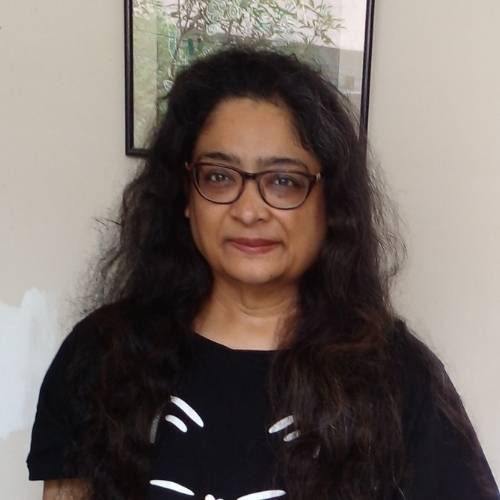
Book Review By Aishwariya Laxmi and K.S. Loganathan
Review copy courtesy Penguin Random House
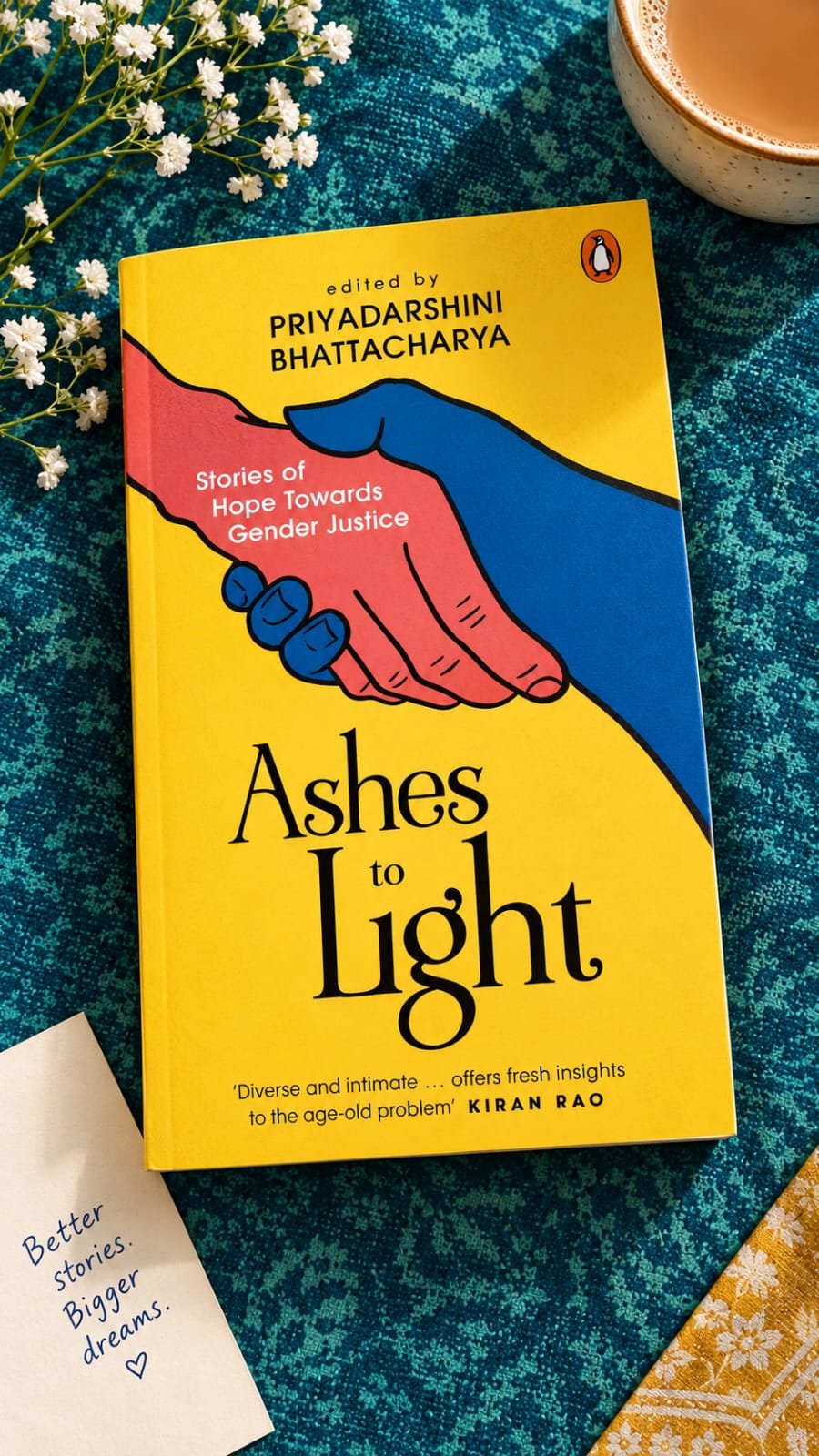
‘Ashes to Light’ features stories of hope towards gender justice. It includes 35 accounts by luminaries in various fields. Ratna Pathak Shah, Deepa Mehta, Kiran Rao, Deepti Naval, Kani Kusruti, and Kiran Bedi are some of the contributors to this anthology, which is edited by Priyadarshini Bhattacharya.
“Together, these essays seek to unsettle the stodgy discourse of gender, injecting it with humor, candor and a refreshing lightness – a kind of academic subversiveness that does not come at the cost of nuance or poignance,” says Ms. Bhattacharya in Chapter 1, Raakh.
Chapter 2 is Reeti by Dev Nath Pathak. He narrates the story of Phool, a young girl living with her peasant parents. Her father arranges her marriage with a man called Harkhit. Initially, all is well, but shortly after, a tragedy befalls her. There are several such stories of male guardians pushing widows to the margins – or worse to claim their property.
In Chapter 3, Parvarish by Ratna Pathak Shah, she asks herself why there were so few rebellious women among her peers. She wondered whether the processes of gendering are so deeply ingrained in our social structures that they were not visible to us. Since 1990, she has been a core team member of an NGO called Avehi- Abacus Project. They researched and curated the curriculum.
In Chapter 4, Kathaa, by Seema Anand, she says, “Misogyny isn’t political radicalization. It is an inherited poison, seeded in the stories you hear as a child. “It all begins with the stories we tell children – stories that teach them, albeit softly, that a woman’s body holds no inherent value.”It is important for us to reclaim the narrative, she says.
Chapter 5, “Jigyasa,” is written by Deepa Mehta, who says that we are all surrounded by stories. She says she trusts her instincts over her intellect. She has delved into the Natya Shastra, an ancient Sanskrit treatise on performing arts, which lays the foundation for Indian drama, stagecraft, and emotional expression. Storytelling is not just about crafting characters – it is about bearing witness.
In Chapter 6, Rasoi, by Pushpesh Pant, he talks about the politics of the kitchen: menstruating women were not allowed inside, lower-caste women were discouraged from cooking since the others in the household wouldn’t want to eat it, and she would be made to feel bad. How the responsibilities in the kitchen fell to the women, while the men largely stayed out of it. Pushpesh Pant’s book on Delhi’s food history, ‘From the King’s Table to Street Food ’ revealed patriarchal prejudices that infiltrated the dining table.
Chapter 7, Khoobsurat, is written by Laxmi Agarwal and Navpreet Kaur. In the chapter, they write about how acid attacks are used as a weapon for revenge and punishment. The attacker wishes to disfigure and destroy a woman, so that she undergoes pain and misery her entire life. Acid attack victims undergo social exclusion and are often subject to mean comments. The authors want to focus on the incredible strength and resilience of the women who have undergone severe cruelty. The writer is the inspiration for the movie Chhapaak ( 2020) starring Deepika Padukone. The victims are now entitled to a minimum compensation of INR 3 lakh, and legal service authorities are assigned to victims. Regulations have also been implemented to control the sale of acid.
In Chapter 18, Rahul Bose, as president of the Indian Rugby Football Union, writes about his efforts in developing a gender-responsive sports ecosystem. Girls especially face an uphill battle to play rugby due to the physicality and sheer intensity of the sport, but there are many who have succeeded in recent years.
In Chapter 22, Sunita Narain says that in India, the forests and other commons are mostly owned by government agencies, but it is the poor, particularly women, who depend on forests for survival. As the Chipko Movement in the Himalayas in the 1970s showed, it is the people, especially women, who stand at the heart of both the forest’s destruction and its salvation. Similarly, managing the global climate requires cooperation that will be possible only if the benefits are distributed equally. We must build ecological assets like renewable energy, rainwater harvesting and resilient food systems and ensure that women are not denied the right to development.
In Chapter 31, D.Y.Chandrachud speaks about the women and cases that shaped his understanding of gender justice: it is never just a ” women’s issue “, it’s a societal one, he avers. He revisited the terminology of judicial phrases to exclude those that reflected patriarchal traditions and which reinforced bias against gender justice. Despite prohibition by law, child marriages still exist. The right to a woman’s privacy is her right to decide to choose whether to marry or not, to have a child or not and to terminate a pregnancy or not.
Kiran Bedi, who was the first woman officer of the Indian Police Service in the 1970s and who retired as Lieutenant Governor of the union territory of Pondicherry in 2021, shows in Chapter 33 how throughout her career she faced male chauvinism and obstructionist tactics by both policemen and bureaucrats who viewed her reforms as intrusion and interference. A position of authority in the government is no guarantee against systemic biases as a woman; it seems, even at present.
The anthology covers a range of situations to which women are exposed as a result of entrenched male beliefs and propensity to violence. It includes 35 narratives from eminent persons in various fields. It would be helpful if a short biography of the writers is included, as well as a glossary of vernacular terms used in the text. The editor makes a powerful plea for gender justice in her pieces, but does not include a call to action for the various issues addressed by the contributors.